Identity and Communication
Posted:
There are important differences in how people in this large, varied consumer community view identity and prefer to communicate.
Language and words related to identity matter and can be tricky to know how to use. Sometimes you must make a judgment call about how you address identity and which related words you choose to use. While you may not satisfy everyone’s preferences, you can become familiar with terms that are generally accepted within the community, as well as those that are not.
Some individuals consider themselves members of the Deaf community, with a unique culture and language. These individuals typically use sign language as their primary language and consider deafness a difference of experience rather than a limitation. Members of the Deaf community may identify as “deaf or hard of hearing.” The word deaf is capitalized (Deaf) when referring to this community to reflect and recognize the shared culture and experiences of its members.
Other individuals view their identities differently. These individuals prefer to or may only communicate using spoken language and are strongly interested in maximizing hearing through personal and assistive technology use. They are more likely to be people who developed their hearing loss as an adult; hence they tend to use people-first language and identify as “people with hearing loss.” Hearing status and communication preference are not necessarily related to their identity in the same way or to the same degree as they are for members of the Deaf community.
As with everything, there are exceptions to these generalizations. Some people may consider themselves members of the Deaf community, use hearing technologies and switch between the use of sign language and spoken communication depending on the situation. Using "individuals with hearing loss, deaf, and hard of hearing" as the language and words in your communications with consumers you want to recruit bridges the various constituencies within this diverse community.
Likewise, there are terms that are generally either considered offensive or inappropriate by this community. We suggest you avoid using the term "hearing impaired." We also suggest you avoid the term "normal" hearing. Instead, we suggest simply using the term "hearing" if you are interested in recruiting hearing individuals along with individuals with hearing loss and deaf or hard of hearing individuals for your product development and testing work.
If you are working with a particular consumer organization, such as the Hearing Loss Association of America (HLAA), the National Association of the Deaf (NAD), or Telecommunications for the Deaf and Hard of Hearing, Inc. (TDI), they can provide guidance with regard to identity terminology and the communication preferences of their constituents. The best practice, because each consumer is a different individual, is to directly discuss with participating consumers their communication access needs and preferences for the particular meeting or event you are hosting.

Communication Access: What to Know
Posted:
ICAAT encourages all companies, from startups to established companies, to provide communication access services for participants in their research and testing activities. Communication access services ensure communication is equally effective for all participants so that everyone can understand what is said or written and can convey messages, so they are understood by others.
In some cases, companies may provide specific communication access services to all participants in a research or testing event. For example, a company may provide automatic speech recognition (ASR) captioning for all participants if they are doing interviews over a videoconferencing platform, such as Zoom or Microsoft Teams. If you feel a provided access service does not meet your communication needs, you should make sure to state this upfront when inquiring about a recruitment opportunity. In other cases, a company may provide communication access services upon request, but the service must be requested by participants in advance of the research or testing event.
While ICAAT believes it is the responsibility of the event host to provide communication access services, it is the responsibility of participants to make their communication access needs known as early as possible. Communication access services can take time to arrange so making your need(s) known as soon as possible is important.
ICAAT provides companies with practical information on various communication access options for people with hearing loss and the best practices for implementing them. Communication access usually involves the provision of one or a combination of the following technologies and services: real-time captioning, assistive listening systems, or sign language interpretation. Equally important is setting communication ground rules for all participants about what is expected of them to support effective communication. If you are unfamiliar with or want to learn more about any of these technologies, services, or practices, you can read the Co-Design Essentials page for Industry on Communication Access.
Non-Endorsement Policy
Posted:
ICAAT cannot be used for marketing purposes. ICAAT does not endorse, promote or advertise any product or service.
Hearing Loss Association of America (HLAA) is a consumer organization, and ICAAT is an HLAA technology program. HLAA provides information and education about technology that can benefit people with hearing loss. HLAA has a strict policy of non-endorsement of goods, products, and services.
Individual consumers participating in ICAAT are prohibited from using the names, logos, or images associated with ICAAT or HLAA via any media, including written testimonies, social media, in photos or videos, to suggest or imply endorsement by HLAA or the ICAAT program in personal representations about goods, products, or services tested or encountered through association with ICAAT.

Consent & Personal Data Usage
Posted:
Ethics is an essential consideration in all types of research that include people and the collection and use of their data. Informed consent is fundamental to ensuring data collection is ethical.
What is informed consent?
Informed consent means that before the research starts,
- you have received all the important details about the research in clear, understandable language,
- you have enough time and opportunity to ask questions and receive clarification, so you fully understand the details of the research, and
- you freely decide whether to participate in the research.
What important details about the research should I receive?
- An explanation with enough detail so you understand the purpose and objectives of the research.
- A description of the activities you will complete and how long those activities are expected to last.
- A description of benefits, if any, that you might reasonably expect from participation in the research.
- A description of risks or discomfort, if any, that you might reasonably expect from participation in the research.
- A statement about how your information and data will be recorded (for example, written, photographic, audio, or video), stored, and used.
- A statement about how your privacy and the confidentiality of your information and data will be handled.
- Information about whether you will receive compensation for your time, expenses incurred, experience, and perspective and what form compensation will take.
- Contact information for a person who can answer any questions, provide clarification, and with whom you can easily and quickly communicate about the research.
- A way for you to consent (for example, by signing a form) to participating in the research.
How will I receive the important details about the research?
You can receive these details in several ways. For example, you might receive the information through face-to-face contact, videoconference, email, mail, telephone, or video. To ensure informed consent, the important details about the research often are provided using a written informed consent form that you sign and date. If you have signed an informed consent form to participate in research, you should receive a copy of it, so you can refer to the form at any time.
Written informed consent forms have several advantages. They provide written documentation. The copy you receive ensures you know what you signed and who to contact about the research. Written forms also provide evidence that the researchers have thought through the important details about the research, and all participants receive the same information.
It is important to note that even if you have signed a form or provided consent in another way, you can change your mind and withdraw anytime, for any reason, or for no reason at all.
Data is valuable and powerful. Organizations have a responsibility to make sure it is protected and used ethically.

What's an NDA?
Posted:
An NDA is a non-disclosure agreement. Sometimes, they also are referred to as confidentiality agreements.
When working with a company whether you are participating in market research, product testing, or some other activity, it is possible the company may require that you sign a non-disclosure agreement or NDA in order for you to participate. NDAs are commonplace business documents companies use to protect any valuable or sensitive information they may provide from becoming public or shared with their competitors.
Non-disclosure agreements are legal documents. They are written contracts that are intended to be enforceable by law, so they should be taken seriously. If you are asked to sign an NDA by a company, you should read the document carefully and ensure that you fully understand your responsibilities described in the agreement. If there is something you do not understand or want more information about, you should seek clarification or ask questions before signing the NDA.
Non-disclosure agreements can take a variety of forms, contain various elements, and have different levels of complexity. However, all non-disclosure agreements have several elements in common. NDAs should:
- include the names of the parties who are involved in providing and receiving the confidential information.
- clearly identify the information that you must keep confidential
- specify when the agreement ends
- describe the consequences if you do not keep the information confidential
The bottom line...
Make sure you understand any document you are asked to sign before signing it. If you sign an NDA, do not share the confidential information you receive from the company with others for as long as the non-disclosure agreement is in effect.

How to Provide a Product Review
Posted:
If you are doing a product review requested by a company, you will want to follow their guidance for providing feedback. However, you do not have to wait for a company to make a request, you can provide your own product review. Product reviews have become commonplace on e-commerce websites, like Amazon, that provide online purchasing. Below are some tips for writing a product review that will help developers understand and become sensitive to your experiences with and feelings about their product. Empathy can be a strong catalyst for bringing about product change. If you post a review on an e-commerce site, you will also want to send the product manufacturer a copy of your review.
5 Tips for Writing a Product Review
1) Provide Context
Part of interpreting product feedback is understanding who is giving the feedback. Provide enough information so that a developer can better understand you and your technology use. Indicate whether you are a new or experienced user of any relevant technology. If you’re an experienced user, describe the frequency and extent to which you have used the technology. It can also be helpful to indicate both your confidence and comfort with the technology used.
For example, instead of saying this:
I’m a hearing aid wearer.
Say something like this:
I’m a successful, long-time (+10 yrs) hearing aid user. I wear my two behind the ear hearing aids all day, every day. Until very recently I haven’t needed to use any assistive technology in combination with my hearing aids. While I’m comfortable using the technology I own, I’m not confident I’m making the best use of the technology I have.
2) State your Goals
Describe why you wanted to purchase the product and what your goals are for using it. Discuss your needs and wants and explain the problem you wanted to solve. What are you trying to accomplish?
For example, instead of saying this:
I need to hear better at work.
Say something like this:
I recently began having more issues hearing in group settings with just my hearing aids. The daily morning stand-up meetings at my company have become more challenging, as have dinners out with family or friends when there are more than 3-4 people in the group. I purchased this remote microphone to hear better in both situations so I can participate more, with more confidence.
3) Be Detailed and Specific
Describe the product and how you are using it in detail. Be specific by providing the make and model of the product you are reviewing, along with any software versions used for operating the product. If you are using the product in conjunction with another product, make sure you provide the same detailed and specific information for all the technologies that are working together.
For example, instead of saying this:
I purchased the BestEver remote microphone.
Say something like this:
I purchased the BestEver remote microphone model xyz and use it with my BestEver hearing aids model xyz. I pair the microphone with my hearing aids using Bluetooth. The pairing process is easy and quick to do. Then I only need to place the microphone near what I want to hear. At work meetings, I put it in the center of the table where we meet. For group dinners, I also place it in the middle of the table.
4) Keep it Personal and Honest
Include your personal thoughts about and experiences with the product without generalizing. Speak for yourself; don’t assume all users will share your thoughts and experiences. Point out what you would consider both positives and negatives of the product. While it’s important to be honest, it’s also important to be objective by providing the reasons behind your opinions.
For example, instead of saying this:
The remote microphone works for me sometimes and not others.
Say something like this:
The remote microphone works best for me in smaller groups of 6-10 people who are sitting around a table. In this situation, everyone’s speech sounds crisp and clear. If I’m in a larger meeting space for work and there’s a presenter, I put the remote microphone near the speaker but that means I may not hear people who are farther away nearly as well if they ask questions or have comments. I’ve also almost walked out of a meeting and forgotten to take the remote microphone with me. I’d love if there was some kind of alert, maybe through an app that lets me know my remote microphone is out of range. I’m not sure I’d want to receive the alert through my hearing aids though.
5) Give a Recommendation
Provide a response to this question at the end of your review: “How likely is it that you'll recommend this product to a friend or colleague who has the same goals for the technology as you do?” One way you can respond is by using a number from 0 to 10, where 0 means you are not at all likely to recommend the product and 10 means you are extremely likely to recommend the product. Explain your recommendation.
For example, instead of saying this:
I might recommend this remote microphone given it’s not too expensive.
Say something like this:
For someone with the same hearing needs as I have, I’d recommend this remote microphone with caution (7 out of 10). It has generally helped me address the problems I’ve been having at work and gatherings with family and friends. However, there are limits to how effective it is when I’m trying to hear people in larger spaces, but these situations happen less often. The benefit I receive is worth the cost of the device, but there are things that could be improved that would increase my satisfaction.
Now Compare
Each example above has been used to create two full reviews so it is easier to compare the different styles.
Review 1
I’m a hearing aid wearer and need to hear better at work so I purchased the BestEver remote microphone. It works for me sometimes and not others. I might recommend this mic given it’s not too expensive.
Review 2
I’m a successful, long-time (+10 yrs) hearing aid user. I wear my two behind the ear hearing aids all day, every day. Until very recently I haven’t needed to use any assistive technology in combination with my hearing aids. While I’m comfortable using the technology I own, I’m not confident I’m making the best use of the technology I have.
I recently began having more issues hearing in group settings with just my hearing aids. The daily morning stand-up meetings at my company have become more challenging, as have dinners out with family or friends when there are more than 3-4 people in the group. I purchased this remote microphone to hear better in both situations so I can participate more, with more confidence.
I purchased the BestEver remote microphone model xyz and use it with my BestEver hearing aids model xyz. I pair the microphone with my hearing aids using Bluetooth. The pairing process is easy and quick to do. Then I only need to place the microphone near what I want to hear. At work meetings, I put it in the center of the table where we meet. For group dinners, I also place it in the middle of the table.
The remote microphone works best for me in smaller groups of 6-10 people who are sitting around a table. In this situation, everyone’s speech sounds crisp and clear. If I’m in a larger meeting space for work and there’s a presenter, I put the remote microphone near the speaker but that means I may not hear people who are farther away nearly as well if they ask questions or have comments. I’ve also almost walked out of a meeting and forgotten to take the remote microphone with me. I’d love if there was some kind of alert, maybe through an app that lets me know my remote microphone is out of range. I’m not sure I’d want to receive the alert through my hearing aids though.
For someone with the same hearing needs as I have, I’d recommend this remote microphone with caution (7 out of 10). It has generally helped me address the problems I’ve been having at work and gatherings with family and friends. However, there are limits to how effective it is when I’m trying to hear people in larger spaces, but these situations happen less often. The benefit I receive is worth the cost of the device, but there are things that could be improved that would increase my satisfaction.
Understanding New Product Development
Posted:
New products and services are developed all the time. In fact, thousands of new products are launched every year.
Sometimes products and services are entering an already established market, and companies hope to distinguish what they sell from their competitors by providing different or more appealing options to consumers.
The American automotive company, Fiskar, entered the electric vehicle market with the express goal of having four completely unique or best-in-class features in every one of their new cars.
At other times, new offerings represent an improvement to an already existing product or service in an established market. This type of new product and service development can help companies stay competitive through incremental improvements over time.
Apple holds an annual conference that has become a launching pad for its new software and hardware product developments.
Other new developments involve products and services that disrupt already existing markets or involve a technological breakthrough that creates a new market.
The Apple iPod disrupted the market for traditional music players when it was introduced in 2001. And Netflix’s video streaming service created a new market that effectively put the movie rental market out of business.
Regardless of whether new products and services fit into or disrupt an already existing market or create an entirely new market, best practices for new product development involve three (3) key phases leading up to product launch.
1) Idea Generation and Screening
During this initial phase, a company generates many concepts and ideas regarding a new product or service. This phase lays the groundwork for the subsequent phases. The ideas generated guide the overall process of product design and development.
New ideas come from sources both internal (management, research and development teams, employees) and external (customers, market research, experts in the field) to the company. The key elements to generating worthwhile ideas include:
- understanding the target audience
- identifying the customers’ needs
- knowing the competition.
Ideally, a company needs to understand the human story behind its target audience. The issues and unmet needs of the consumer must be well described in order to be solved.
The generated ideas go through a screening process to filter out a few viable ones, eliminating those that are not technically feasible or too costly. External factors also influence a company’s final decision, such as market potential, regulatory requirements, and manufacturing considerations. One idea with the highest potential for success is chosen.
2) Concept Development and Testing
Rough sketches or digital models are created to visualize the selected product idea. A detailed design concept of the product is developed, including features, functions, aesthetics, and branding. Complete versions of user stories for the product are also generated.
Tests are then conducted with the target audience to gather feedback and identify potential improvements. Designs are created and recreated based on this testing and feedback, which ensures that problems are discovered sooner, and changes can happen earlier.
At the same time, the company will undertake a business analysis. Market research, risk assessment, and financial projections are conducted. Analyses of the results provide an understanding of the potential costs, revenues, and profitability of the product idea.
3) Product Development and Testing
When the new product design concept is in place, a prototype or sample of the product is developed for testing and validation. During this phase, design and engineering are involved to develop a basic, functional first version of the product for market testing. Other important development considerations include incorporating accessibility features - a key goal of ICAAT - and ensuring the product design complies with relevant regulations and standards.
Once a viable product is developed, market testing is used to evaluate its performance and functionality, as well as consumer experiences with the product. The test results and consumer feedback are incorporated throughout the ongoing development process. The product also may be introduced to a limited number of consumers in the target audience to assess its performance in a real-world setting, gather additional feedback, and identify other necessary adjustments.
Based upon all the testing results, a company will decide whether to begin large-scale production and commercialization of the product for release into the market. Detailed documentation and guidelines for consumer use will be created, and full-scale production, distribution, and marketing plans will be implemented to make the product available to consumers.

Consumers with Hearing Loss
Posted:
Co-Design Essentials provides practical information for consumers when working with industry through ICAAT.
Our practical information touches on various topics, including a description of new product design stages, tips for writing your own product review, a discussion of how confidential information about a product as well as your own personal information may be handled, what to know about making sure your communication access needs are met, and expectations around endorsements.
Communication Access
Posted:
For individuals with hearing loss and Deaf consumers to fully participate in any activity, their communication access needs must be met. The best and most direct way to understand those needs is to ask the consumer. Consumers generally know their own communication needs. It is the responsibility of the host to provide communication access.
It is important to know that regardless of whether consumers prefer to listen and speak for themselves or prefer to use sign language, consumers generally rely on both visual and auditory information to varying degrees to maximize communication. For example, someone with hearing loss may need to see a speaker's face and utilize speechreading to better understand what they are hearing. Another consumer who uses sign language may also want to hear the speaker and meeting participants, and other non-speech information (e.g., the sound of a door opening) that might occur during the meeting.
Providing an accommodation without checking in with the consumer risks losing everyone’s time and money and most importantly, the goodwill and trust of the consumer. If the wrong accommodation is chosen, it can be completely useless to the consumer. For example, someone might have significant hearing loss, but no understanding of sign language. Provision of a sign language interpreter, in that case, would not help communication at all. Likewise, for someone who uses American Sign Language, the use of captioning as a substitute for sign communication can impact understanding of what others are saying and reduce or eliminate the person’s ability to provide input to spoken conversation.
The best way to meet the needs expressed by the consumer is to have knowledge of the various communication access options and the best practices for implementing them. Communication access usually involves the provision of one or a combination of the following technologies and services: real-time captioning, assistive listening systems, or sign language interpretation. Equally important is setting communication ground rules for all participants about what is expected of them to support effective communication.
Real-Time Captioning
Captioning is a process by which speech is transcribed into text. Not only should live meetings and events be made accessible by providing real-time captioning of all participants' speech, but any media played during these occasions should be closed captioned as well. For media, there are many captioning vendors that can prepare high-quality closed captions; make sure they follow guidelines for best practices.
For real-time captioning, there are two ways this service is provided.
Communication Access Realtime Translation (CART):
CART services are performed by a trained human transcriptionist called a CART writer. The CART writer uses a stenography machine with a phonetic keyboard and special computer software that translates the phonetic symbols into captions. CART can be provided on-site, in-person. It can also be provided remotely using an audio connection for the CART writer to receive the speech and an Internet connection to transmit the text to the consumer.
CART writers who provide onsite or remote captioning can be found in many communities. The National Court Reporters Association (NCRA) certifies court reporters who demonstrate their proficiency in the skills needed to provide CART or captioning services. Look for a CART writer who is a Certified Realtime Reporter (CRR). You can find certified CART providers in your area by searching the NCRA professional directory or contacting a local court reporting firm to get a referral.
Best Practices:
- Book a CART writer as soon as possible; it can be difficult to find CART writers on very short notice.
- Provide the CART writer with as much information about your meeting or event in advance as possible, for example, the names of those participating and any presentation material that will be used; CART writers follow a code of ethics that requires all information provided in advance of and shared during a meeting or event be kept confidential.
- Pay attention to the audio conditions; good microphone pick of everyone’s speech and quiet conditions with minimal extraneous sounds are key to achieving high-quality captioning.
- Schedule breaks in your program at intervals recommended by the CART writer; CART provision is both physically and mentally demanding work, and breaks are required.
- Consider the location of any screen dedicated to the display of captions relative to the primary speaker and any other screens used to display presentation materials for in-person meetings or events.
- Know how to enable caption viewing through the video conferencing software being used for consumers participating remotely; inform participants about how to see the captions and any useful captioning features (e.g., being able to adjust caption location or size) available to them for adjustment.
Automatic Speech Recognition (ASR) Captioning:
Real-time captioning can also be performed by a machine using automatic speech recognition (ASR) software and a computer interface; no human intervention is involved. Captions provided using ASR are generally not as well accepted nor are they considered to be equivalent to CART for communication access.
ASR captioning can differ in important ways from CART captioning. For example, some ASR captions may not include punctuation, speaker identification, or non-speech information (e.g., a barking dog or phone ringing). Some software may struggle with background music or non-English accents. If you decide to use an ASR platform to provide access, be sure to know what the weak points are for that program, and account for them. Let consumers know that you will be using ASR captioning.
ASR captioning is available through mobile apps, internet browsers for smartphone, tablet, or computer use, videoconferencing software, and presentation software. Some applications are free; others have fees. Live Transcribe by Google, Live Captions by Microsoft, Otter, and AVA are a few examples of ASR captioning that can be downloaded or used via the web. Examples of videoconferencing software with ASR captioning include Zoom automated transcription, Google Meet live captions, and Skype live captions. Presentation software such as Microsoft Powerpoint and Google Slides have ASR captioning capabilities. An Internet search will provide the latest entries into this marketplace.
Best Practices:
- Pay attention to the audio conditions; good microphone pick of everyone’s speech and quiet conditions with minimal extraneous sounds are key in achieving high-quality captioning.
- Know how to enable caption viewing for whatever captioning application, presentation software, or video conferencing software is being used.
- Instruct participants about what, if anything, they need to do to see the captions.
- Inform participants at the beginning of the meeting or event about any useful captioning features (e.g., being able to adjust caption location or size) available to them for adjustment.
- Have someone who is hearing monitor the captions and be willing to make corrections as they are needed.
Assistive Listening Systems
Even among individuals who benefit from and choose to use personal hearing devices, these devices may not be enough to provide full communication access, especially in certain circumstances and under certain conditions. Distance from the desired sound source can reduce the level of the signal of interest; noise in the environment can make speech harder to understand. In combination, these two factors can further reduce the communication experience of personal hearing device users. Other aspects of the acoustic space, such as reverberation, can reduce sound clarity. One way these issues can be addressed is with an assistive listening system.
All assistive listening systems contain the same basic components. A direct electrical connection to or microphone near the sound source is critical. The sound is then transmitted wirelessly using one of several methods to a receiver worn by the listener. The receiver is connected to the individual’s ear or their personal hearing device’s microphone using a headset. If the personal hearing device is equipped with a telecoil, a neckloop can be used for inductive coupling to the telecoil. And in the case of an induction hearing loop system, the device’s telecoil acts as the receiver and will be able to connect to a hearing loop directly and wirelessly.
Assistive listening systems are effective. They provide better objective measures of speech understanding in noise than with personal hearing devices alone. Individuals using these systems report improvement in perceived communication performance, improved listening satisfaction in specific situations, and reduced listening effort.
Currently, there are several main types of assistive listening systems used by people with hearing loss during in-person meetings and events. These systems are not for use during remote meetings and events.
Hearing Induction Loop Systems
Hearing Induction Loop Systems consist of a copper wire placed within a room that is connected via a special loop “driver” to a public address or sound system and a microphone. An electromagnetic field is created that can be picked up directly by a telecoil in hearing aids or cochlear implants. People who do not have hearing devices or who do not have access to telecoils in their hearing devices or a streamer need to use a hearing loop receiver and wired headset to connect to the system.
Infrared (IR) Systems
IR Systems transmit sound wirelessly using invisible infrared light waves. Infrared light cannot penetrate walls or ceilings. As a result, this system is often used in situations where a secure signal is required. However, it cannot be effectively used outdoors during the daytime due to the IR signal being affected by sunlight. In settings where there are poor sightlines, users might experience interference or receive no sound at all. Anyone using the system needs a receiver and either a wired headset or neckloop.
Frequency Modulation (FM) Systems
FM Systems transmit sound wirelessly using low-power FM radio transmission. FM systems can transmit several hundred feet within and outside the room with the transmitter. Anyone using the system needs a receiver and either a wired headset or neckloop.
WiFi Systems
WiFi systems stream sound wirelessly over a WiFi network. The receiver, typically a smartphone, must be WiFi capable. A compatible application, usually available for both iOS and Android smartphones, must be downloaded to select and utilize the appropriate WiFi network transmitting the audio stream. This allows individuals to use their own smartphones as receivers. A wired headset or neckloop is required to transmit the audio from the phone to the person's hearing device or ear. While a Bluetooth connection between the smartphone and hearing device may work, it can introduce delays in the audio signal received by the listener or increase power requirements of the phone and hearing device; either or both may be unacceptable.
A note about Bluetooth:
We also expect increased use of Bluetooth wireless connectivity for assistive listening. Currently, many hearing aids and some cochlear implants can connect via Bluetooth to another device, like a cell phone or personal listening accessory, mostly using proprietary extensions. However, it is not possible to use Bluetooth to broadcast audio from one source, like a presenter at a meeting, directly to anyone attending the meeting and listening through a personal hearing device. When a new version of Bluetooth LE, called Bluetooth LE-Audio, becomes integrated into personal hearing devices, it should provide for more seamless access to audio on any device or in any space that implements it.
The availability and use of Bluetooth LE-Audio in public spaces, in personal consumer devices like computers and cell phones, and in hearing aids and cochlear implants will happen gradually over the next several years. The eventual goal is for Bluetooth LE-Audio and its broadcast capability, branded as Auracast, to be used everywhere and support full interoperability among devices. Bluetooth LE-Audio and Auracast will coexist with traditional assistive listening technology for the foreseeable future.
There are several assistive listening system vendors:
Best Practices:
- Ensure good audio conditions, particularly good microphone pick of everyone’s speech, and a quiet location.
- Practice setting up the assistive listening system in advance, so you are familiar with its operation.
- Verify the system is fully charged or has new batteries, with extra batteries and equipment available if they become needed.
- Ask the participants how they prefer to connect to the system being used; assistive listening systems should provide a means to connect the system to consumers' personal hearing devices or directly to their ears.
- Consider the time it will take for participants to receive and/or set up any assistive listening equipment in your calculations for the overall meeting time.
Sign Language Interpretation
Some individuals rely on or prefer to use sign language for communication. The use of real-time captioning should not be considered an adequate substitute for communication access for these individuals unless they indicate otherwise. While there are several types of interpreting, American Sign Language (ASL) interpreting is the most typical form of interpreting requested today. Interpreters must be fluent in both languages, ASL and English, to be effective. Interpreting can be provided on-site, in-person. It can also be provided remotely using an audiovisual connection.
The Registry of Interpreters for the Deaf (RID) and the National Association for the Deaf (NAD) certify interpreters who demonstrate their proficiency in the skills needed to provide ASL interpreting. Look for an interpreter who is RID or NAD certified. Interpreters may be hired directly or through an interpreter agency or service. The Registry of Interpreters for the Deaf (RID) provides searchable databases for individual interpreters and interpreter agencies and referral services by city, state, and/or zip code. Not all interpreters, agencies, or services are RID members and, as a result, may not be listed.
Best Practices:
- Book ASL interpreters as soon as possible; it can be difficult to find interpreters on very short notice, and more than one may be required depending on the number of participants and duration of your program.
- Provide the interpreters with as much information about your meeting or event in advance as possible, for example, the names of those participating and any presentation material that will be used; Interpreters follow a code of ethics that requires all information provided in advance of and shared during a meeting or event be kept confidential.
- Schedule breaks in your program at intervals recommended by the interpreter; Interpreting is both physically and mentally demanding work, and breaks are required.
- Pay attention to the audio conditions; the ability to hear everyone’s speech clearly and quiet conditions with minimal extraneous sounds are key to achieving high-quality interpretation.
- Ask the advice of the consumers and interpreters as to the best location for the interpreters when having in-person meetings.
- Know how to pin the interpreter’s video within the video conferencing software being used for consumers participating remotely so the interpreter can always be viewed regardless of who is speaking.
Communication Ground Rules
Communication access is not only about providing a technology or service solution, managing communication behavior by establishing communication ground rules is also very important to ensure clear communication and full participation for individuals with hearing loss and Deaf consumers. For example, managing turn-taking in a group by establishing some simple rules upfront, like - one person speaks at a time, raise your hand to speak, and identify yourself before you speak - can have a dramatic impact on the ease and effectiveness of communication for everyone and the usefulness of any technologies or other means of communication access being employed. Setting up an environment conducive to effective communication can significantly enhance the results of your session and the quality of information you receive.
Best Practices:
- Request that only one person speaks at a time.
- Ask people to raise their hands to speak and identify themselves before speaking; this aids not only the consumer but any CART writer or interpreter providing communication access services.
- Get listeners' attention before starting to speak.
- Face listeners directly.
- Pause to let everyone read and look at your slides or other presentation material before you speak to it; take this into account when deciding the length of any session you are running.
- Rephrase if you are not understood.
- Give clues when changing the subject.
- Provide written instructions in advance of and at the time of the meeting or event.
- Ensure the room is well-lit and eliminate backlighting so all speakers' faces can be easily seen to facilitate speech reading; cues on the face during communication are important whether you are communicating by voice or by sign.
Hearing Technology Use
Posted:
Individuals with hearing loss use both personal hearing devices and assistive listening systems to maximize their communication access.
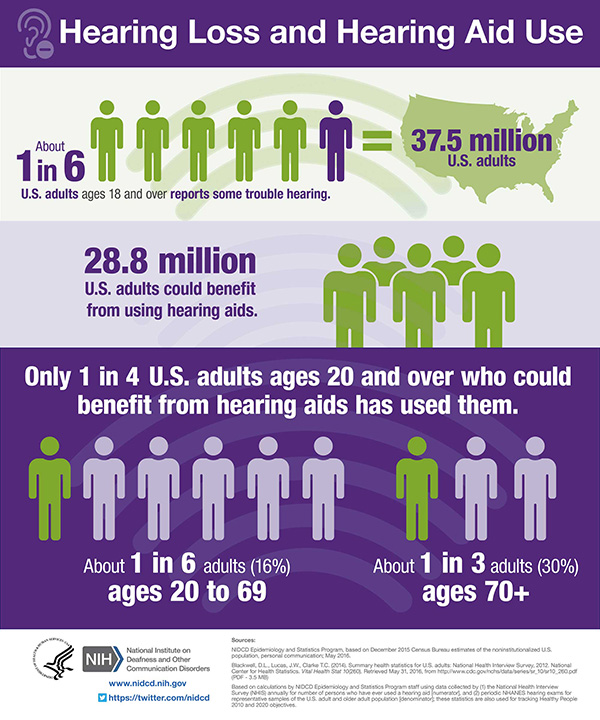
Although underused, the most common technology utilized by people with hearing loss for communication access is a personal hearing device that has been programmed for their specific hearing characteristics and needs. These devices include over-the-counter hearing aids, prescription hearing aids, and cochlear implants. Less often, personal sound amplification products may be used by people with hearing loss.
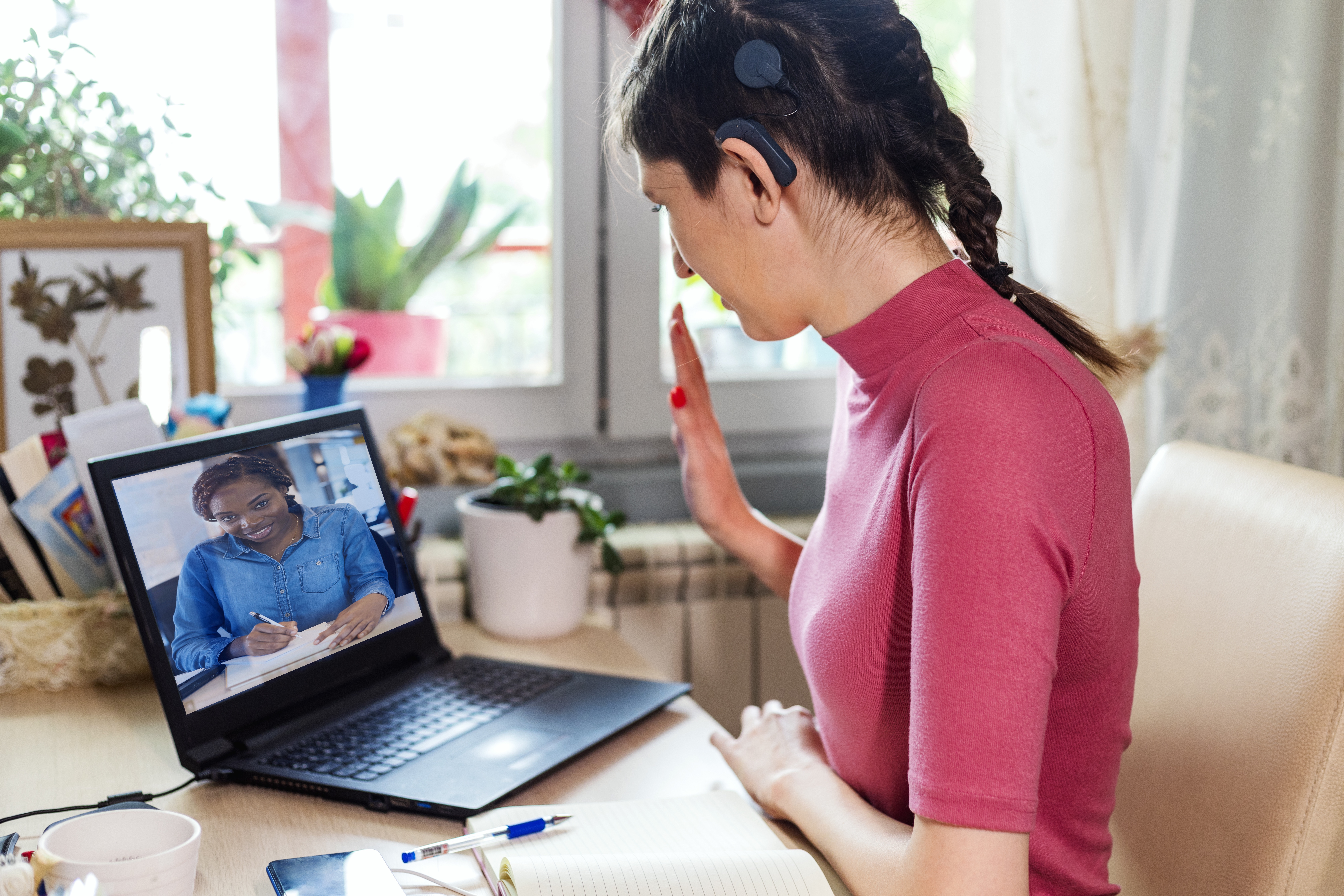
Deaf individuals may find that personal hearing devices provide very limited access to sound. Because of this minimal benefit and in some cases, cultural preferences, some people who are deaf choose not to wear a personal hearing device. These individuals use technologies that afford visual communication access, such as video calling apps, visual home alerting devices, and television captioning.
Personal Hearing Devices
Hearing aids
The Food and Drug Administration (FDA), which regulates hearing aids as medical devices, defines a hearing aid as a “sound-amplifying device designed to aid people who have impaired hearing.” This simple definition obscures the very sophisticated devices that modern hearing aids have become. Hearing Tracker provides a guide to hearing aid manufacturers, brands, and features. The FDA has defined two regulatory categories of hearing aids: Over-the-Counter Hearing Aids and Prescription Hearing Aids. Both are electronic medical devices. They differ in terms of their intended users and conditions for sale.
Over-the-Counter Hearing Aids: The FDA defines over-the-counter (OTC) hearing aids as hearing aids for adults with perceived mild-to-moderate hearing loss that may be purchased directly by consumers without the involvement of a licensed professional. OTC hearing aids are regulated by the FDA with clear labeling as to use, safety and efficacy. This option allows for affordable and easily accessible hearing aids.
Prescription Hearing Aids: The FDA defines prescription hearing aids as hearing aids for people of any age and any degree of hearing loss. A prescription is needed to purchase these devices, and in some states, they must be purchased from a licensed professional.
Cochlear implants
The FDA also regulates cochlear implants, which it defines as “electronic hearing devices.” These devices are very complex, consisting of an external microphone and sound processor that typically sits behind the ear and a surgically implanted electrode array placed in the cochlea of the inner ear. Sound picked up by the microphone is processed and transmitted to the electrode array, where electrical impulses are delivered as a representation of sound.
Personal Sound Amplification Products
Personal sound amplification products (PSAP) are considered consumer electronics products rather than medical devices. They are intended to enhance typical hearing, not address hearing loss. Nevertheless, individuals with hearing loss may choose to purchase and use a PSAP to accommodate their personal hearing needs. PSAPs are not regulated by the FDA. However, the FDA does have non-binding guidance on PSAPs that includes recommendations and their current thinking on this type of device.